

RF Engineering Consulting Services from 1 Hz to 300 MHz
SiberSci, LLC designs and troubleshoots RF circuits and systems from ELF through VHF, at power levels from receiver front ends to multi-kilowatt transmitters and heaters. Founder & CTO Dr. Scott Best, Ph.D., combines hand analysis, electromagnetic simulation and lab measurement so designs work the first time they are built. Related work includes the RF heating systems SiberSci designs at 6.78 to 40.68 MHz.
RF problems SiberSci solves:
- Matching networks that drift, overheat or arc at high power
- Filters and resonators that miss frequency, bandwidth or Q
- Amplifiers and oscillators with instability, spurs or poor efficiency
- Interference and signal integrity problems in mixed RF and digital boards
- Conductor losses from skin effect and proximity effect
Contact SiberSci, LLC to start your RF engineering project.
RF Engineering at a Glance
| Frequency range | 1 Hz to 300 MHz (free-space wavelength from 300,000 km down to 1 m) |
| Applications | Two-way and broadcast radio, RFID, RF heating and plasma sources, particle accelerators, aircraft and submarine communications, ham radio |
| Typical hardware | Lumped LC and parallel-plate resonators, filters, couplers, power combiners, phase shifters, delay lines, matching networks, amplifiers and oscillators |
| Simulation tools | Ansys HFSS, CST Studio Suite, COMSOL, FEKO, Sonnet, Keysight ADS and Genesys |
| Measurement | Lab capability from 1 µHz to 300 GHz |
| Led by | Dr. Scott Best, Ph.D., Founder & CTO, IEEE Life Senior Member, 3 U.S. patents |
RF Bands and Wavelengths
| ITU band | Frequency | Free-space wavelength |
|---|---|---|
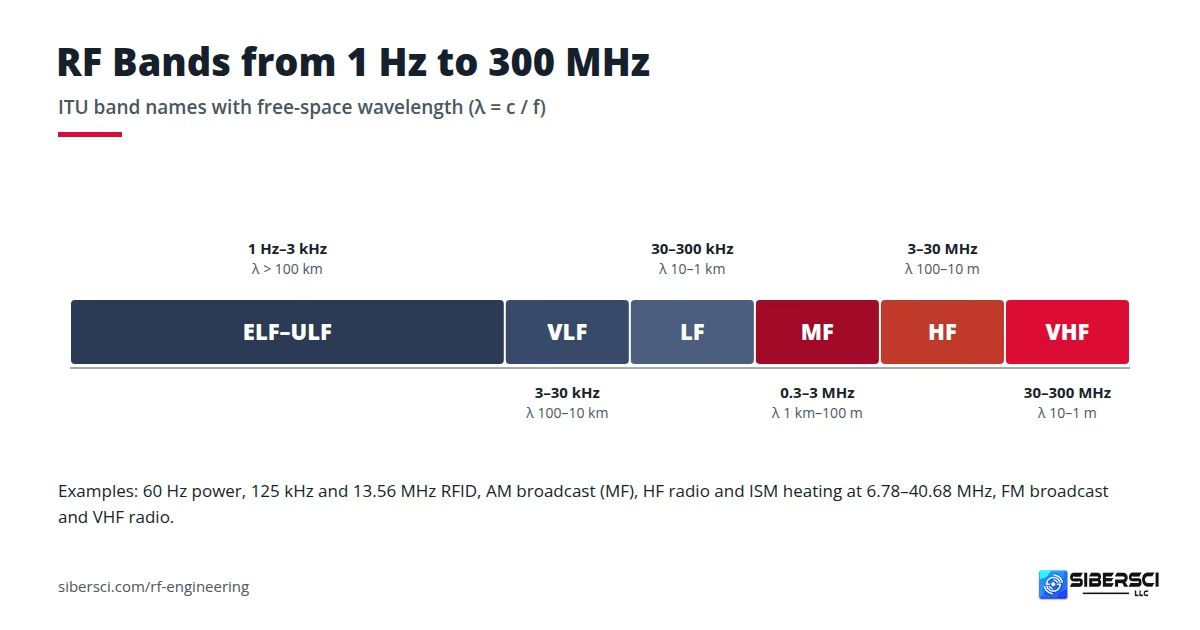
| ELF, SLF, ULF | Below 3 kHz | Over 100 km |
| VLF | 3–30 kHz | 100–10 km |
| LF | 30–300 kHz | 10–1 km |
| MF | 300 kHz–3 MHz | 1 km–100 m |
| HF | 3–30 MHz | 100–10 m |
| VHF | 30–300 MHz | 10–1 m |
At these wavelengths most circuits are far smaller than λ, so lumped inductors and capacitors are often the right tool. Use the wavelength calculator for any frequency.
Worked Example: A 13.56 MHz Resonator
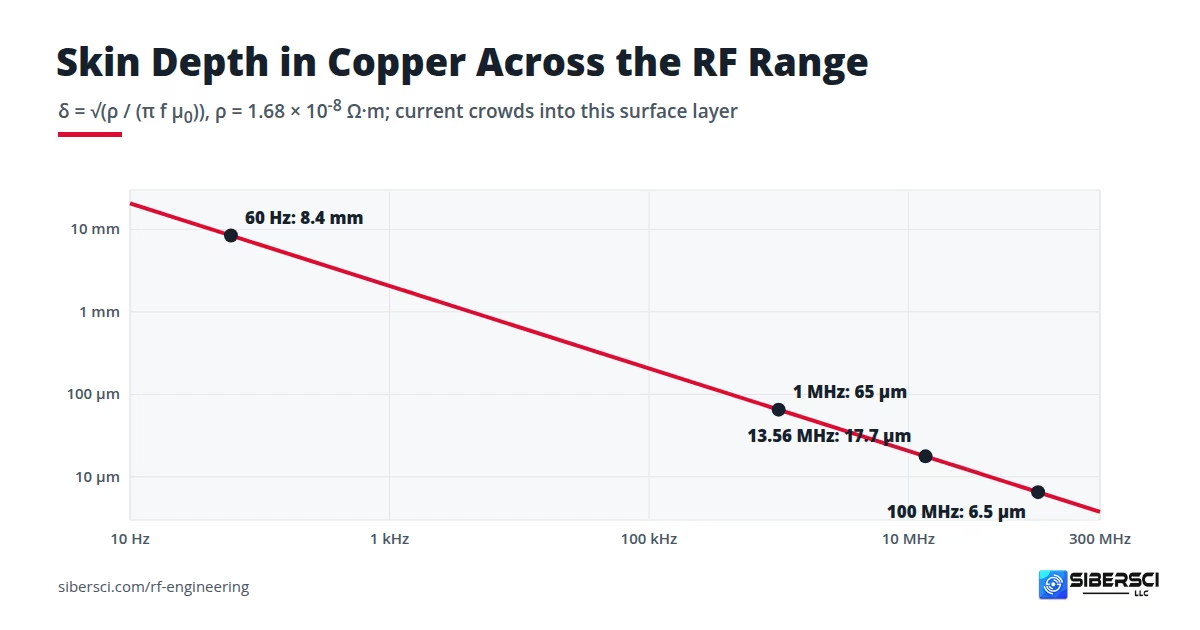
An LC circuit resonates at f = 1 / (2π√(LC)). With a 1 µH inductor, resonance at 13.56 MHz takes 137.8 pF. A change of just 1 pF moves the resonance about 49 kHz, seven times the ±7 kHz FCC tolerance, which is why these circuits use a trimmer capacitor or automatic tuning. At that frequency the RF current in copper flows mostly within one skin depth of the surface, δ ≈ 17.7 µm, so the inductor's resistance depends on surface area and finish, not on the full wire cross section. You can check other metals and frequencies with the skin depth calculator.
What SiberSci Designs, Tests and Fixes
Each project begins under an NDA with your performance targets and size limits. SiberSci recommends one or more ways to build the hardware, flags any target that cannot be reached, and explains what would need to change. Typical work includes:
- Passive circuits: lumped lowpass, bandpass, highpass and band-reject filters; couplers; phase shifters; delay lines; impedance matching networks
- Resonators and lines: LC, coaxial, cylindrical, rectangular and clamshell resonators; coax, microstrip, stripline, coplanar and ridged waveguide lines
- Active circuits: amplifiers, oscillators and power combiners and splitters
- Systems: RF front ends, software-defined radio hardware, beamforming networks, signal integrity and system analysis
Simulation Grounded in Measured Materials
SiberSci works in HFSS, CST, COMSOL, FEKO, Sonnet, ADS or Genesys, on your licenses or through contract access, and helps you choose if you are unsure. Every model is checked against hand calculations and uses measured permittivity, loss tangent and conductivity at your frequency and temperature. When that data is missing, SiberSci arranges for the materials to be measured.
Electromagnetic Engineering Consulting Services offered:
- Antenna Engineering - https://sibersci.com/antenna-engineering/
- Microwave Engineering - https://sibersci.com/microwave-engineering/
- Microwave Heating Engineering - https://sibersci.com/microwave-heating-engineering/
- Millimeter-Wave Engineering - https://sibersci.com/millimeter-wave-engineering/
- RF Engineering - https://sibersci.com/rf-engineering/
- RF Heating Engineering - https://sibersci.com/rf-heating-engineering/
- RF and Microwave Safety - https://sibersci.com/rf-and-microwave-safety/
- Do not hesitate to ask if you need help solving a problem.
Electromagnetic Engineering Calculators offered:
- Circular Waveguide Calculator - https://sibersci.com/circular-waveguide-calculator/
- Coax TEM Mode Calculator - https://sibersci.com/coax-tem-mode-calculator/
- Dielectric Heating Calculator - https://sibersci.com/dielectric-heating-calculator/
- Rectangular Waveguide TEm,n Calculator - https://sibersci.com/rectangular-waveguide-temn-calculator/
- Rectangular Waveguide TMm,n Calculator - https://sibersci.com/rectangular-waveguide-tmmn-calculator/
- Skin Depth Calculator - https://sibersci.com/skin-depth-calculator/
- Wavelength Calculator - https://sibersci.com/wavelength-calculator/
Are You Ready To Begin Work On Your RF Engineering Project?
Your problem is waiting to be solved, so please submit an inquiry for an RF Engineering Consulting project to Dr. Scott Best, and clearly specify if a Non-Disclosure Agreement (NDA) is required to protect your business-sensitive information, Intellectual Property (IP), or Proprietary Data (PD). SiberSci, LLC will provide an NDA for review, negotiation, and amendment by the client to safeguard and protect their IP and PD. SiberSci, LLC will also provide a budgetary quotation and schedule for performing the client-defined RF Consulting effort after reviewing the performance and size requirements. Work on the RF Consulting project commences when a contract has been negotiated and legally executed by SiberSci, LLC and the client.
RF Engineering FAQ
FAQ
What RF engineering consulting services does SiberSci, LLC provide?
SiberSci, LLC provides RF engineering consulting for two kinds of work: troubleshooting and optimizing existing RF circuits and systems, and the research, design, development, fabrication, testing, validation, and optimization of new client-defined RF hardware. Services cover RF devices, circuits, assemblies, subsystems, and complete systems, supported by theoretical analysis and computational electromagnetic (CEM) simulation.
What frequency range does SiberSci's RF engineering work cover?
SiberSci's RF engineering services cover hardware operating from 1 Hz to 300 MHz. Projects above 300 MHz are handled through SiberSci's Microwave Engineering and Millimeter-Wave Engineering consulting services.
What types of RF hardware can SiberSci design or optimize?
SiberSci designs and optimizes RF filters (lowpass, bandpass, highpass, and band-reject), RF amplifiers and oscillators, power combiners and splitters, impedance-matching circuits, RLC and parallel-plate resonators, coaxial, cylindrical, rectangular, and clam-shell resonators, delay lines, phase shifters, couplers, RF front-ends, Software-Defined Radios (SDRs), and beamforming networks. SiberSci also performs signal integrity (SI) analysis and RF systems analysis.
Which transmission line types does SiberSci work with?
SiberSci analyzes and designs RF transmission line networks using coaxial line, rectangular waveguide, ridged waveguide, cylindrical waveguide, elliptic waveguide, and planar circuits, including microstrip, stripline, and coplanar waveguide (CPW).
Can SiberSci fix performance problems in an existing RF system?
Yes. Optimizing the performance of existing RF circuits and systems is a core SiberSci service. Clients with equipment that is underperforming, failing specifications, or behaving unexpectedly can contact SiberSci for diagnosis and engineering recommendations.
Can SiberSci review my RF specifications or proposed design before I build hardware?
Yes. SiberSci reviews client performance specifications, size constraints, and client-proposed hardware configurations to determine whether a concept suits the intended application. The review documents the performance and physical limitations of each design concept, recommends one or more hardware configurations that meet the requirements, and identifies any specification that is physically impossible to achieve, along with recommendations for working around that barrier.
What electromagnetic simulation (CEM) software does SiberSci use?
SiberSci is experienced with Ansys HFSS (within Ansys Electronics Workbench), CST Microwave Studio, FEKO, COMSOL, Sonnet Software, and Keysight ADS, and Genesys. Clients may specify one or more of these tools if they provide a valid license or pay for contract access to the code. If a client is unsure which tool fits the project, SiberSci helps select the appropriate CEM software.
Why do material properties matter for RF circuit simulation?
The accuracy of an RF circuit simulation depends directly on the frequency- and temperature-dependent properties of its metals and dielectrics, including complex permittivity, loss tangent, electrical conductivity, thermal conductivity, density, and specific heat. SiberSci uses laboratory and contract resources to measure these properties so that simulations are based only on valid material data.
What applications and industries use SiberSci's RF engineering expertise?
RF engineering supports a wide range of applications, including police and fire radios, AM, FM, and television broadcasting, amateur (ham) radio, linear accelerators for particle physics, garage door openers, aircraft and submarine communication systems, and industrial RF heating of food products. SiberSci works across a wide range of power levels and circuit topologies, and RF heating projects are covered by its RF Heating Engineering service.
Will SiberSci sign a non-disclosure agreement (NDA)?
Yes. When a client states that an NDA is required, SiberSci provides an NDA for the client to review, negotiate, and amend in order to protect business-sensitive information, intellectual property (IP), and proprietary data (PD).
How do I start an RF engineering consulting project with SiberSci?
Email Dr. Scott Best at scott_best@sibersci.com or call 270-228-4901 with a description of the project, and state whether an NDA is required. After reviewing the performance and size requirements, SiberSci provides a budgetary quotation and schedule. Work begins once a contract has been negotiated and executed by both SiberSci and the client.
Who leads SiberSci's RF engineering work?
SiberSci, LLC is built on the professional experience of Dr. Scott Best, an electromagnetic engineer with experience in both industry and government. SiberSci is based in Owensboro, Kentucky, is a BBB Accredited Business, and is listed in the IEEE-USA Consultants Database.
Does SiberSci offer other electromagnetic engineering services besides RF?
Yes. SiberSci also provides Antenna Engineering, Microwave Engineering, Microwave Heating Engineering, Millimeter-Wave Engineering, RF Heating Engineering, and RF and Microwave Safety consulting, and accepts projects outside these categories on request.
Does SiberSci provide free RF engineering calculators?
Yes. SiberSci offers free online calculators for wavelength, skin depth, coax TEM mode, circular waveguide, rectangular waveguide, rectangular waveguide TEm,n and TMm,n modes, and dielectric heating.



Consulting Services
Contact
SiberSci, LLC is ready to begin solving your Electromagnetic Engineering problems today.