
RF and Microwave Safety Training and Consulting
SiberSci, LLC trains technicians, engineers, managers and business owners to recognize and control RF and microwave exposure hazards, and reviews labs and plants against FCC and OSHA requirements. Training and assessments are led by Founder & CTO Dr. Scott Best, Ph.D., an IEEE Life Senior Member with decades of hands-on work on high-power RF, microwave and millimeter-wave equipment.
Services are available for individuals, work groups, departments and whole companies in academic, R&D, industrial, government and military settings. Contact SiberSci, LLC to discuss your concerns and requirements.
Why RF and Microwave Safety Training Matters
Almost everyone now works and lives surrounded by RF and microwave signals. Common sources include:
- AM and FM radio and digital TV transmitters
- Microwave ovens and industrial microwave and RF heating systems
- Cellular networks (4G LTE and 5G, with 6G in development), Wi-Fi, Bluetooth and IoT devices
- Weather, air traffic control, collision avoidance and military radars
- Satellite systems such as Starlink, Eutelsat OneWeb, Amazon Kuiper, Qianfan (SpaceSail), Iridium, Globalstar, SiriusXM, and the GPS, Galileo, GLONASS and BeiDou navigation systems
- Medical, scientific and industrial equipment, including plasma and semiconductor process tools
Most of this exposure is far below safety limits. The risk is concentrated near high-power equipment: transmitters, heaters, waveguide runs, antennas under test and open test setups. RF and microwave energy cannot be seen, smelled or heard, and it is often not felt until the exposure is already high. At high levels this non-ionizing radiation heats body tissue much as a microwave oven warms a meal. Lower frequencies penetrate deeper, so heating can happen below the skin before any warmth is noticed. The eyes are especially at risk because they have little blood flow to carry heat away.
A trained workforce is the best protection. SiberSci's courses meet regulatory training needs and also explain the physics, so employees replace worry with understanding and know exactly which practices keep them safe: knowing where the sources are, how strong they are, and how distance, time and shielding reduce exposure.
Who Sets RF Exposure Limits: FCC, OSHA, FDA and the States
RF and microwave safety is often overlooked in universities, labs, factories, government sites and military facilities. Ignoring the hazard does not remove it; it only makes an injury more likely. Everyone from lab technicians to the C-suite should know which rules apply:
| Agency | Rule | What it sets |
|---|---|---|
| FCC | 47 CFR 1.1310 | Maximum permissible exposure (MPE) limits from 300 kHz to 100 GHz for occupational and general-public exposure, and SAR limits from 100 kHz to 6 GHz |
| OSHA | 29 CFR 1910.97 | A 10 mW/cm² radiation protection guide from 10 MHz to 100 GHz, averaged over any 0.1 hour, and the RF hazard warning sign |
| FDA | 21 CFR 1030.10 | Microwave oven leakage: no more than 1 mW/cm² at 5 cm before sale and 5 mW/cm² over the oven's life |
| States | State OSHA plans | Many states run their own occupational safety programs with their own requirements |
OSHA usually becomes involved after an accident, to investigate and document its cause. The FCC does not investigate workplace injuries, but it does investigate interference with licensed radio services.
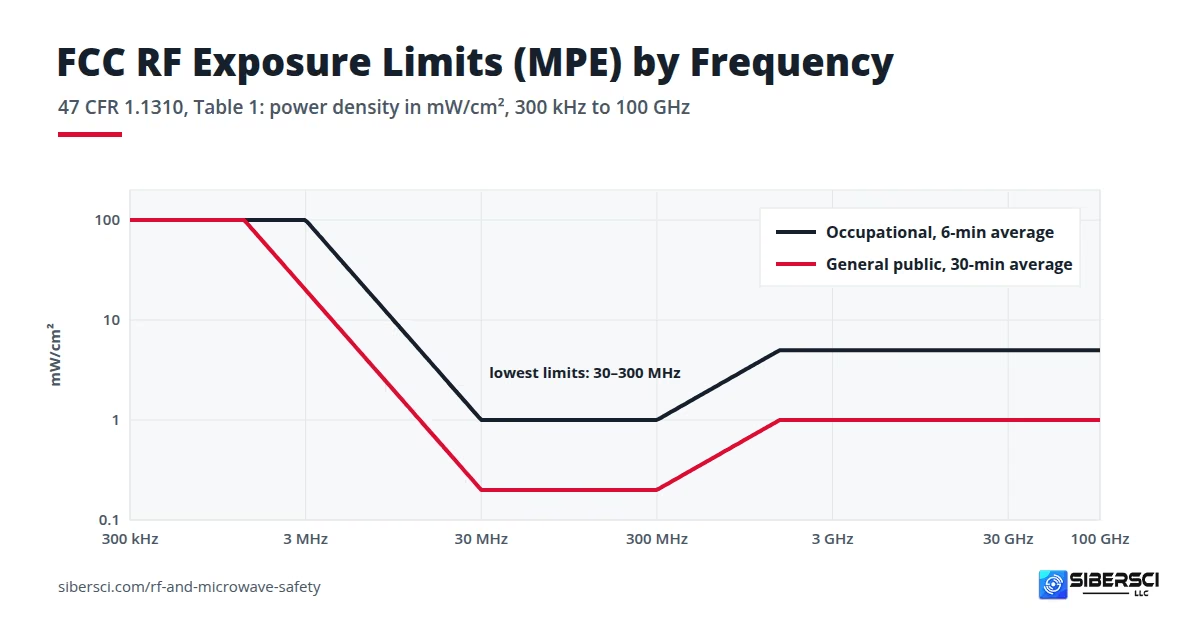
FCC Exposure Limits at Common Frequencies
| Frequency | Occupational limit (6-minute average) | General public limit (30-minute average) |
|---|---|---|
| 13.56 MHz | 4.89 mW/cm² (E = 136 V/m) | 0.98 mW/cm² (E = 60.8 V/m) |
| 30–300 MHz | 1.0 mW/cm² (E = 61.4 V/m) | 0.2 mW/cm² (E = 27.5 V/m) |
| 915 MHz | 3.05 mW/cm² | 0.61 mW/cm² |
| 1.5–100 GHz, including 2.45 GHz | 5 mW/cm² | 1.0 mW/cm² |
Calculated from Table 1 of 47 CFR 1.1310. Below 30 MHz the limits are plane-wave equivalent power densities; E-field and H-field limits also apply.
SiberSci works with anyone who needs help with RF or microwave safety, from a single engineer to a whole company. Contact SiberSci to discuss your concerns and requirements.
RF and Microwave Safety Services and Training Topics
SiberSci, LLC helps individuals and companies find and fix RF and microwave safety problems. Services provided to date include the list below. If your topic is not listed, ask; most needs can be covered.
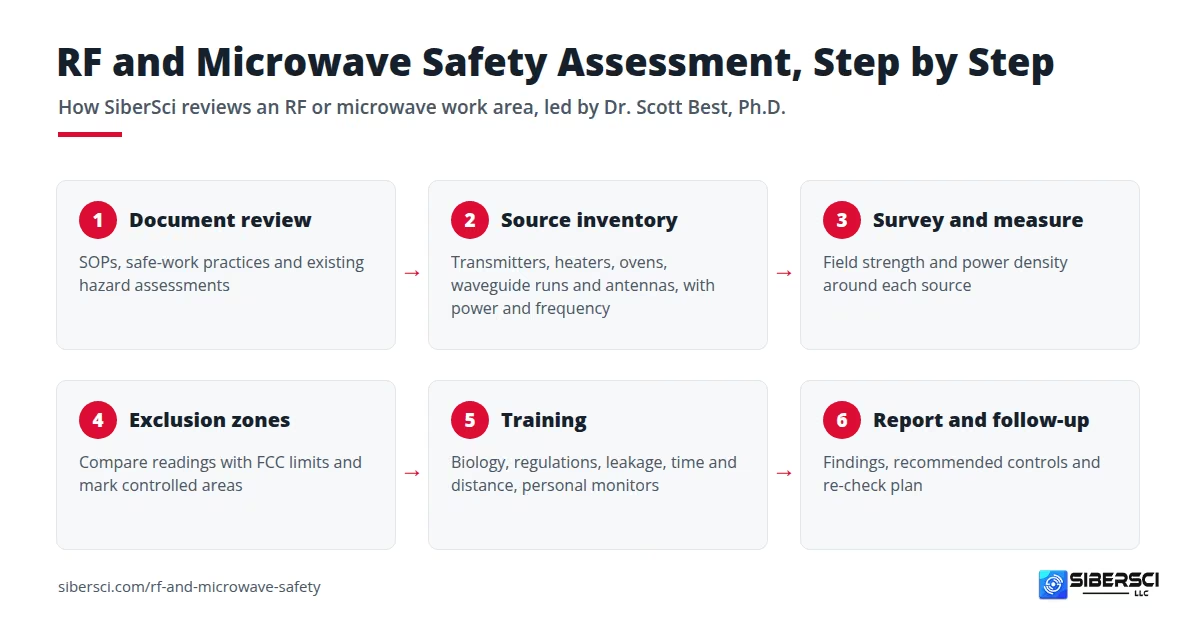
- Document review: written SOPs, safe-work rules and hazard assessments covering your RF and microwave equipment
- On-site reviews: equipment in academic and R&D labs, industrial plants, government sites and military facilities
- Exclusion zones: analysis of equipment layout and measured field data to define where access must be controlled
Training Topics
- Biology of RF and microwave exposure: ionizing versus non-ionizing radiation; the parameters that set your exposure; effects of excessive exposure; how RF and microwave energy heats tissue
- Leakage and radiation: waveguide leakage and antenna radiation theory
- Regulations and standards: FCC and OSHA RF exposure rules
- Safe work practices: using distance and time averaging around active RF and microwave sources; avoiding eye injury from waveguide leaks
- Sources of RF and microwave energy: vacuum electron devices and solid-state sources
- Personal RF exposure monitors: options, features, proper use and limits of RF, microwave and millimeter-wave monitors
- Open discussion: time to answer your team's questions and concerns
For more on building a training program, read RF safety training for engineering teams.
SiberSci, LLC Electromagnetic Engineering Consulting Services
Antenna Engineering Services
Microwave Engineering Services
Microwave Heating Engineering Services
Millimeter-Wave Engineering Services
RF Engineering Services
RF Heating Engineering Services
Let’s Get Started with your Electromagnetic Engineering Project!
SiberSci, LLC provides clients with Electromagnetic Engineering Consulting Services to address their individual Electromagnetic Engineering needs. We offer services to research, design, develop, prototype, optimize, and manufacture devices, circuits, and systems for clients. We also provide services for failure analysis of devices, circuits, and systems, as well as reverse engineering competitor devices and circuits.
Next, SiberSci, LLC provides technical support for the creation of new patents, as well as reviewing existing patents to identify weaknesses and assist clients in avoiding infringement. We also provide technical expert testimony for various situations.
Finally, if you are seeking assistance with solving an Electromagnetic Engineering problem, then contact SiberSci, LLC by telephone or e-mail to initiate a discussion of your requirements. A Non-Disclosure Agreement (NDA) will be negotiated and executed to protect your Intellectual Property (IP) before the details of your project are disclosed. A quote is provided at this time for services to be rendered, along with a contract defining the work to be performed for the client.
SiberSci, LLC is looking forward to working with you on your project and solving your problem(s) in one of our six areas of Electromagnetic Engineering expertise.
SiberSci, LLC Electromagnetic Engineering Consulting Services:
- Solve a performance problem(s) with a product.
- Develop a new product to satisfy an industrial, consumer, medical, avionics, or military requirement.
- Resolve a manufacturing problem with a product to improve the first-pass yield, reduce scrap, and improve profitability for the product.
- Cost reduction of a product to maintain or enhance performance while improving profitability.
- Provide expert witness testimony regarding the design, assembly, and performance of an electromagnetic circuit, subsystem, system, or product.
- Provide theoretical, analytical, and numerical electromagnetic engineering design services for both existing and new products.
- Provide laboratory measurement and characterization services for electromagnetic hardware and assemblies.
- RF and Microwave Safety Services.
Electromagnetic Engineering Consulting Services offered:
- Antenna Engineering - https://sibersci.com/antenna-engineering/
- Microwave Engineering - https://sibersci.com/microwave-engineering/
- Microwave Heating Engineering - https://sibersci.com/microwave-heating-engineering/
- Millimeter-Wave Engineering - https://sibersci.com/millimeter-wave-engineering/
- RF Engineering - https://sibersci.com/rf-engineering/
- RF Heating Engineering - https://sibersci.com/rf-heating-engineering/
- RF and Microwave Safety - https://sibersci.com/rf-and-microwave-safety/
- Do not hesitate to ask if you need help solving a problem.
Electromagnetic Engineering Calculators offered:
- Circular Waveguide Calculator - https://sibersci.com/circular-waveguide-calculator/
- Coax TEM Mode Calculator - https://sibersci.com/coax-tem-mode-calculator/
- Dielectric Heating Calculator - https://sibersci.com/dielectric-heating-calculator/
- Rectangular Waveguide TEm,n Calculator - https://sibersci.com/rectangular-waveguide-temn-calculator/
- Rectangular Waveguide TMm,n Calculator - https://sibersci.com/rectangular-waveguide-tmmn-calculator/
- Skin Depth Calculator - https://sibersci.com/skin-depth-calculator/
- Wavelength Calculator - https://sibersci.com/wavelength-calculator/
RF and Microwave Safety FAQ
FAQ
What is RF and Microwave Safety?
RF and Microwave Safety is the practice of identifying, measuring, and controlling human exposure to non-ionizing electromagnetic energy, roughly 3 kHz to 300 GHz. It covers hazard assessment, exposure limits, exclusion zones, safe work practices, and training so that technicians, engineers, scientists, and managers can work around RF and microwave equipment without injury.
Is RF and microwave radiation the same as ionizing radiation like X-rays?
No. RF and microwave energy is non-ionizing: its photons do not carry enough energy to break chemical bonds or strip electrons from atoms the way X-rays and gamma rays do. The established hazard from RF and microwave exposure is heating of body tissue, which becomes dangerous when exposure is high enough to overwhelm the body’s ability to carry heat away.
What are the health effects of excessive RF and microwave exposure?
The primary established effect is tissue heating. Excessive exposure can cause burns, including deep burns beneath the skin that may not be felt right away, and heat stress. The eyes and testes are especially vulnerable because they have limited blood flow to remove heat, and cataracts are a documented risk from high-level microwave exposure to the eye. Because RF energy is invisible, odorless, and often cannot be felt until levels are high, injuries can occur without warning.
What factors determine how much RF exposure a person receives?
Exposure depends on operating frequency, transmitted power, distance from the source, duration of exposure, duty cycle (pulsed or continuous), antenna gain and pointing direction, and whether the person is in the near field or far field. In the far field, power density falls with the square of distance, so doubling your distance from a source cuts exposure to about one quarter. Exposure limits are also averaged over time, which is why distance and time are the two most important tools in safe work practices.
What regulations and standards govern RF exposure in the United States?
The FCC sets RF exposure limits for FCC-regulated transmitters in 47 CFR § 1.1310, with separate limits for occupational/controlled and general population/uncontrolled environments. OSHA addresses non-ionizing radiation in 29 CFR 1910.97 and can cite employers for recognized hazards under the General Duty Clause. Consensus standards such as IEEE C95.1 and the ICNIRP guidelines are also widely used, and states with their own occupational safety plans may add requirements.
What is the difference between occupational and general population RF exposure limits?
Occupational/controlled limits apply to people who are aware of their potential exposure and can exercise control over it, which generally requires RF safety training. General population/uncontrolled limits apply to everyone else and are five times lower in power density. Under FCC rules, occupational exposure is averaged over 6 minutes and general population exposure over 30 minutes. Without documented training, workers may have to be held to the stricter general population limits.
What is an RF exclusion zone and how is it determined?
An RF exclusion zone is the area around an antenna, waveguide, transmitter, or RF/microwave system where exposure may exceed allowable limits, so access must be restricted or controlled. It is defined by analyzing the equipment layout and operating parameters together with measured or calculated field levels, then marking the boundary with signage, barriers, or interlocks. SiberSci, LLC analyzes equipment layouts and measured radiation data to define exclusion zones for client facilities.
Why is waveguide leakage dangerous, especially to the eyes?
Leaks at loose or damaged waveguide flanges, joints, and open ports can emit concentrated microwave energy in a narrow beam. Looking into an open or leaking waveguide places the eye directly in that beam, and because the lens of the eye has very little blood flow, it is particularly susceptible to thermal damage. Never look into an energized waveguide or antenna, verify flange connections, and survey for leakage after maintenance or reconfiguration.
Who needs RF and microwave safety training?
Anyone who works on or near RF and microwave equipment needs it: lab technicians, engineers, scientists, and maintenance staff, as well as the supervisors, managers, directors, and executives responsible for them. Typical settings include academic and R&D laboratories, industrial microwave and RF heating systems, communications and broadcast sites, radar installations, and government and military facilities.
What topics does SiberSci’s RF and microwave safety training cover?
SiberSci, LLC training covers: the biology of RF and microwave exposure, including ionizing versus non-ionizing radiation, exposure parameters, biological effects, and tissue heating; waveguide leakage and antenna radiation theory; FCC and OSHA RF exposure regulations and standards; safe work practices, including using distance and time averaging and avoiding eye damage from waveguide leaks; sources of RF and microwave energy, from vacuum electron devices to solid-state; and RF, microwave, and millimeter-wave personal exposure monitors. Each session ends with open discussion of the group’s own questions and concerns.
Do personal RF exposure monitors replace RF safety training?
No. Personal RF exposure monitors are wearable devices that alarm when field levels approach or exceed a set fraction of exposure limits. They are a valuable safeguard, but each model has a specific frequency range, sensitivity, and response time, and it only measures the field where it is worn. Workers need training to choose the right monitor, wear it correctly, interpret alarms, and understand its limitations, which is why SiberSci training covers RF, microwave, and millimeter-wave monitor options, features, use, and limitations.
How much microwave leakage is allowed from a microwave oven or industrial microwave system?
Microwave ovens sold in the United States must meet FDA standard 21 CFR 1030.10, which limits leakage to 1 mW/cm² at 5 cm from the oven surface at manufacture and 5 mW/cm² over the life of the oven. Industrial microwave and RF heating systems operate at far higher power than kitchen ovens, so they depend on engineered shielding, chokes, interlocks, and periodic leakage surveys to keep personnel exposure within occupational limits.
What RF and microwave safety services does SiberSci, LLC provide?
SiberSci, LLC reviews written RF and Microwave Standard Operating Procedures, Safe Work Practices, and hazard assessment documentation; performs onsite safety reviews of equipment in academic labs, R&D labs, industrial facilities, government sites, and military sites; analyzes equipment layout and measured radiation data to define exclusion zones; and delivers RF and microwave safety training. Services are available to individuals, work groups, divisions, departments, and entire companies, and custom topics can be requested.
Who provides SiberSci’s RF and Microwave Safety services?
SiberSci, LLC is an electromagnetic engineering consulting firm based in Owensboro, Kentucky, built on the industry and government experience of Dr. Scott Best. Its safety services draw on the same expertise behind its antenna, RF, microwave, millimeter-wave, and RF and microwave heating engineering work. SiberSci is listed in the IEEE-USA Consultants Database and is a BBB Accredited Business.
How do I get started with RF and microwave safety training or an onsite review?
Contact SiberSci, LLC by phone at 270-228-4901, by email at scott_best@sibersci.com, or through the contact page. Describe your equipment, frequencies, power levels, facility type, and the number of people who need training, and SiberSci will discuss your requirements and provide a quote.

SiberSci, LLC is built upon the professional experience of Dr. Scott Best, who has worked in both industry and government. His professional experience has witnessed dramatic changes in techniques available for solving Electromagnetic Engineering problems, as well as for performing laboratory measurements and experiments.


Consulting Services
Contact
SiberSci, LLC is ready to begin solving your Electromagnetic Engineering problems today.