
RF and Microwave Engineering Calculators
Free online calculators for RF, microwave and millimeter-wave design, built by Dr. Scott Best, Ph.D., Founder and Chief Technology Officer of SiberSci, LLC. Each calculator shows the equations it uses, a step-by-step tutorial with worked examples, and an FAQ, so you can check every result by hand. No sign-up is required.
Which Calculator Do I Need?
Find your question in the left column and open the matching calculator.
| If you need to find… | Use this calculator |
|---|---|
| Wavelength, half- and quarter-wavelength, wave impedance or velocity in air or any dielectric | Wavelength Calculator |
| How thick a metal or plating layer must be at a given frequency | Skin Depth Calculator |
| Coax characteristic impedance, TE1,1 cutoff, guide wavelength or loss | Coax TEM Mode Calculator |
| Cutoff, impedance, guide wavelength and attenuation for any TE or TM mode in a rectangular waveguide | Rectangular Waveguide Calculator |
| The same results for TEm,n modes only | Rectangular Waveguide TEm,n Calculator |
| The same results for TMm,n modes only | Rectangular Waveguide TMm,n Calculator |
| Cutoff frequencies of the first ten TE and TM modes in a round waveguide or vent | Circular Waveguide Calculator |
| RF power, electric field or penetration depth needed to heat a dielectric material | Dielectric Heating Calculator |
Wave and Material Calculators
Wavelength Calculator
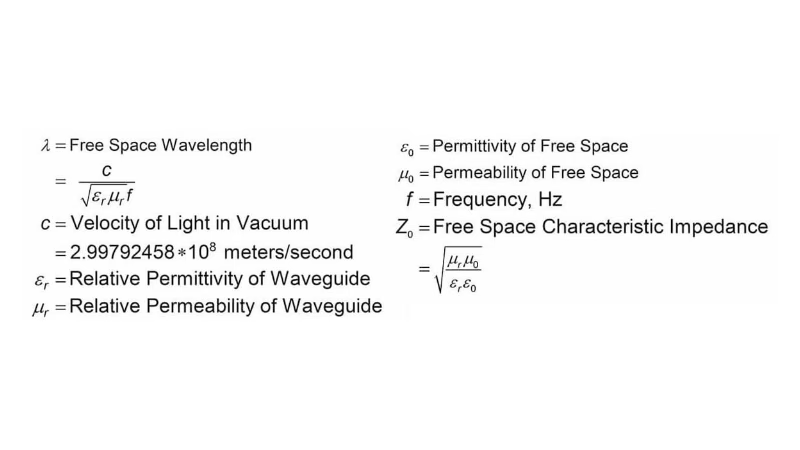
Finds the wavelength, half-wavelength, quarter-wavelength, wave impedance and wave velocity for a plane wave in free space or in any uniformly filled dielectric.
Skin Depth Calculator
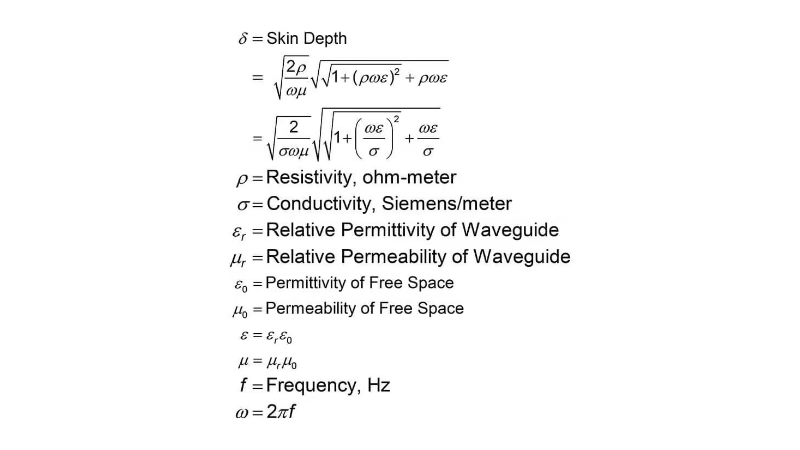
Calculates skin depth in microns, so you know the minimum metal or plating thickness for low-loss RF, microwave and millimeter-wave circuits. Choose from 10 common metals or enter your own conductivity.
Transmission Line and Waveguide Calculators
Coax TEM Mode Calculator
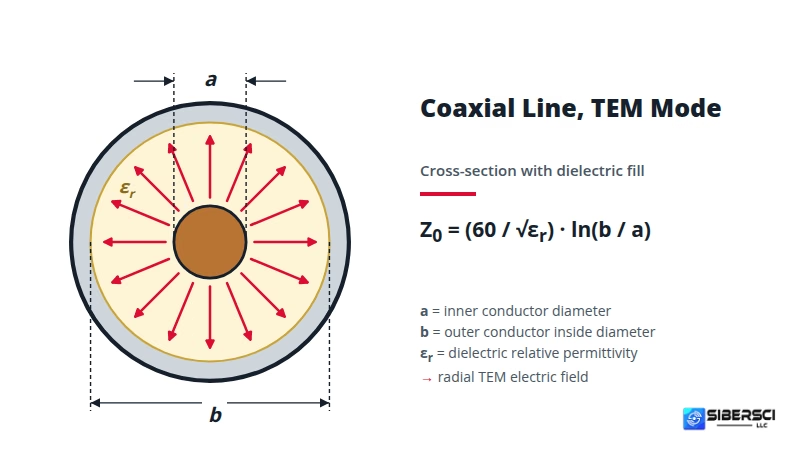
Analyzes a coaxial transmission line from its dimensions and materials. Returns the characteristic impedance, TE1,1 cutoff frequency, guide wavelength, propagation constant, phase and group velocity, and attenuation.
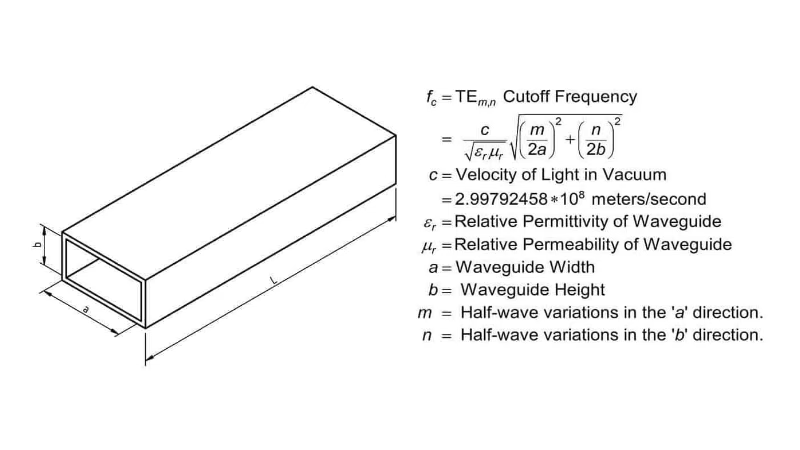
Rectangular Waveguide Calculator (TE and TM Modes)
Calculates TE and TM modes side by side for any mode indices (m, n): cutoff frequency, wave impedance, guide wavelength, propagation constant, phase and group velocity, and attenuation.
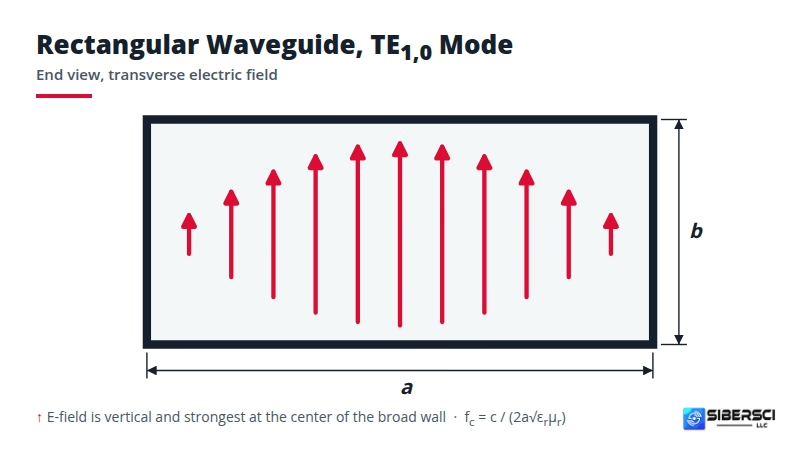
Rectangular Waveguide TEm,n Calculator
The TE-mode-only version of the rectangular waveguide calculator, with tutorials on guide wavelength, slot spacing and finding frequency from a measured guide wavelength.
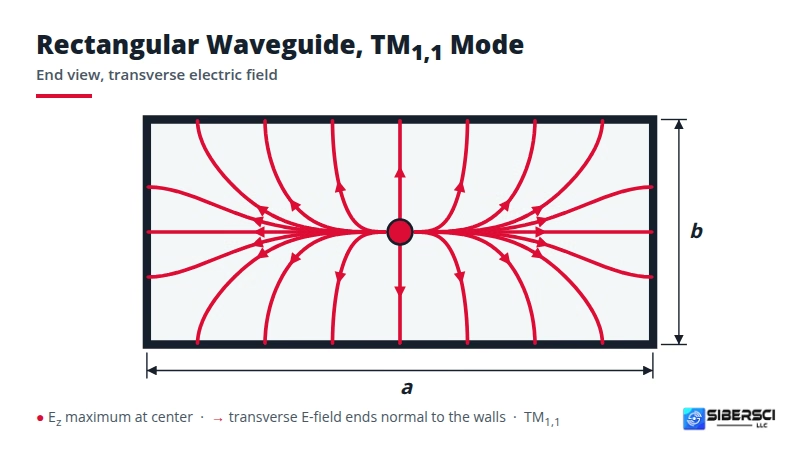
Rectangular Waveguide TMm,n Calculator
The TM-mode-only version (m and n both 1 or higher), with tutorials on TM1,1 guide wavelength, dielectric-filled guides and sizing a TM1,1p cavity.
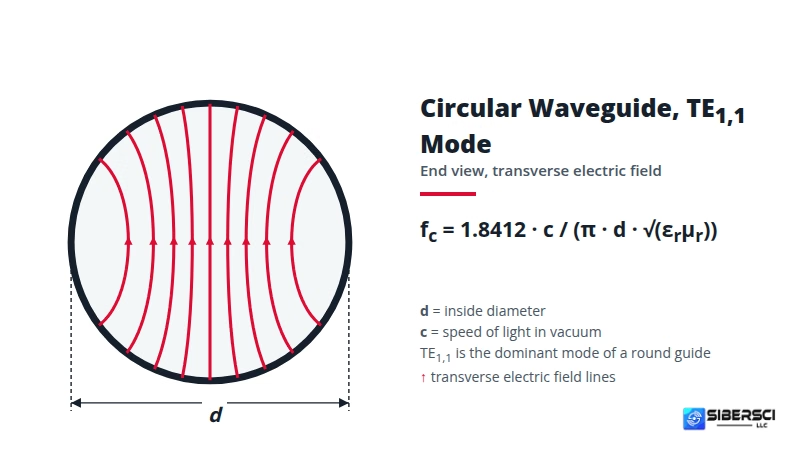
Circular Waveguide Calculator
Returns the cutoff frequencies of the ten lowest TE and TM modes in a round waveguide. Use it to check single-mode operation or to design a waveguide-below-cutoff vent.
Microwave and RF Heating Calculator
Dielectric Heating Calculator
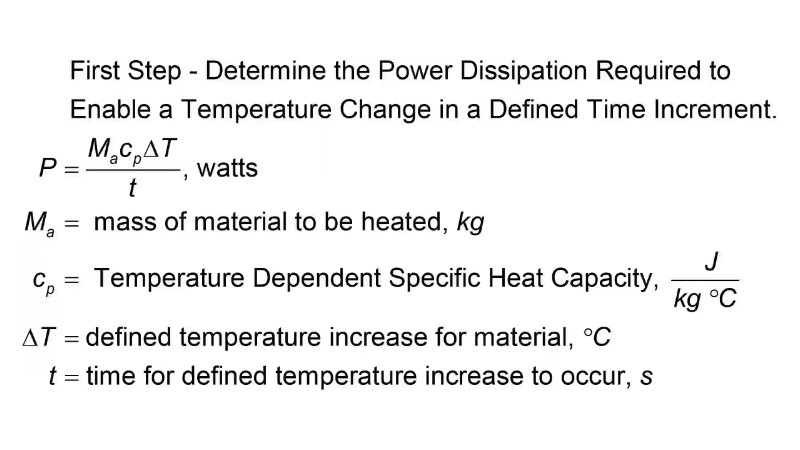
A 1-D analysis of microwave or RF heating of a dielectric material using temperature- and frequency-dependent properties. Finds the RF power needed for a set temperature rise in a set time, the electric field needed, the power penetration depth, and the power dissipated per unit volume.
Related Engineering Guides
- Transmission Line Impedance Calculator Guide: which inputs drive a credible impedance result, why calculated values can miss the target, and how to use the results in design work.
- SiberSci Engineering Blog: articles on antennas, waveguides, mmWave packaging and RF heating.
How These Calculators Work
Every SiberSci calculator uses closed-form equations from standard electromagnetic theory, and each page lists the equations and its references. Results assume ideal geometry: smooth walls, isotropic materials and a single frequency. Real hardware can differ because of surface roughness, manufacturing tolerances, temperature and higher-order effects. Use the calculators for design estimates and hand checks. For production designs, confirm results with full-wave simulation or measurement.

Built and maintained by Dr. Scott Best, Ph.D. in Electrical Engineering (University of Utah), Founder and Chief Technology Officer of SiberSci, LLC, an electromagnetic engineering consulting firm in Owensboro, Kentucky, founded in 2013.
Calculator FAQ
FAQ
Are the SiberSci calculators free?
Yes. All eight calculators are free to use online with no sign-up or download.
How accurate are the results?
The calculators solve the standard closed-form equations exactly for the values you enter. Accuracy in practice depends on your inputs (dimensions, conductivity, permittivity, and loss tangent) and on how closely your hardware matches the ideal model.
What's the difference between the three rectangular waveguide calculators?
The Rectangular Waveguide Calculator shows TE and TM modes together. The TEm,n and TMm,n calculators each handle one mode family and include tutorials for that family. All three use the same inputs and equations.
What units do the calculators use?
Frequency is entered in Hz or MHz as labeled on each calculator, dimensions in millimeters or meters as labeled, and conductivity in Siemens per meter. Each page lists its exact input and output units.
Can I use these calculators for a production design?
Use them for first-pass sizing and to check simulation or test results. For production hardware, confirm the design with full-wave electromagnetic simulation and measurement. SiberSci can help with both.
Can SiberSci help when a calculator isn't enough?
Yes. SiberSci provides antenna, RF, microwave, millimeter-wave, RF heating and microwave heating engineering, plus RF safety consulting. Contact us to discuss your project.
Need More Than a Calculator?
When a design goes beyond closed-form equations (complex geometries, multiphysics heating, mmWave packaging or field failures), SiberSci provides full electromagnetic analysis, simulation and test support.