
Millimeter-Wave Engineering Consulting Services from 30 to 300 GHz
SiberSci, LLC designs, simulates and measures millimeter-wave circuits, antennas and waveguide components from Ka band through D band, where wavelengths shrink from 10 mm to 1 mm. Founder & CTO Dr. Scott Best, Ph.D., has designed 76–81 GHz automotive radar antenna arrays and works from planar circuits up through waveguide, horns and lenses. SiberSci's lab measures up to 300 GHz.
Millimeter-wave problems SiberSci solves:
- Loss and mismatch at chip-to-board, board-to-waveguide and flange transitions
- Performance that shifts with machining tolerance, plating or substrate variation
- Radar and 5G arrays with poor gain, sidelobes or beam steering
- Unknown permittivity and loss of substrates and radomes above 30 GHz
- Moving a lab design into production
Contact SiberSci, LLC to start your millimeter-wave engineering project.
Millimeter-Wave Engineering at a Glance
| Frequency range | 30 to 300 GHz (free-space wavelength 10 mm to 1 mm) |
| Applications | Automotive radar at 76–81 GHz, 5G FR2, satellite and secure links, radio astronomy, imaging, defense systems |
| Typical hardware | Mixers, up- and down-converters, GaN and GaAs amplifiers, Gunn oscillators, filters, couplers, horns, lenses and arrays |
| Simulation tools | Ansys HFSS, CST Studio Suite, COMSOL, FEKO, Sonnet, Keysight ADS and Genesys |
| Measurement | Lab capability up to 300 GHz |
| Led by | Dr. Scott Best, Ph.D., Founder & CTO, IEEE Life Senior Member, 2 IEEE Transactions on MTT papers |
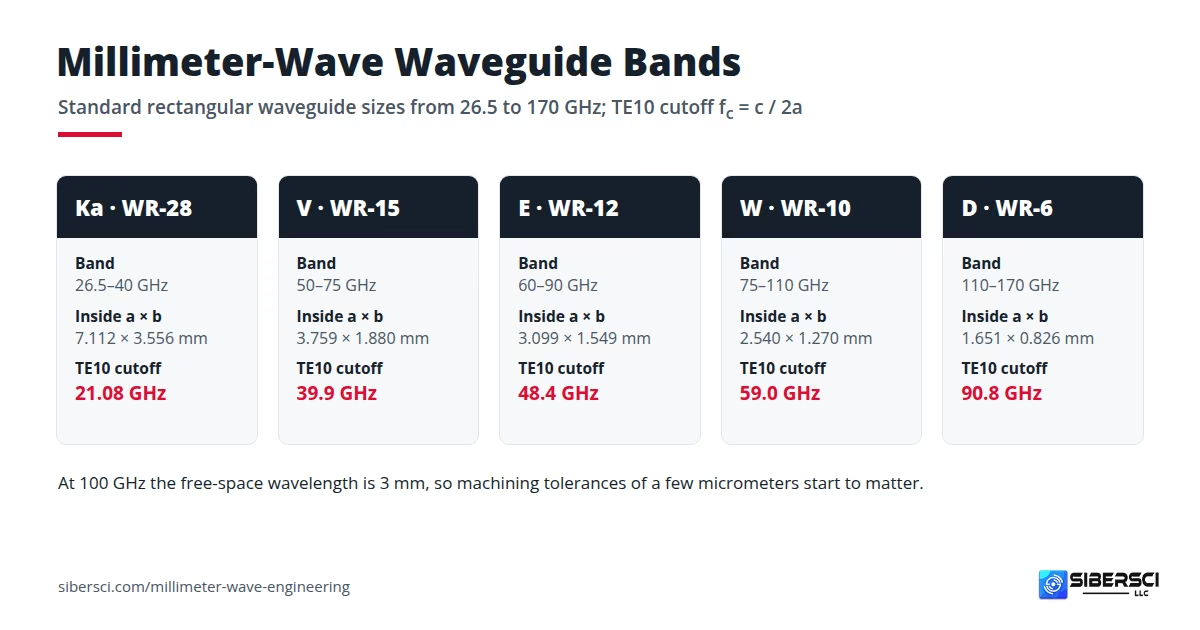
Millimeter-Wave Waveguide Bands
| Band and size | Frequency | Inside a × b | TE10 cutoff |
|---|---|---|---|
| Ka, WR-28 | 26.5–40 GHz | 7.112 × 3.556 mm | 21.08 GHz |
| V, WR-15 | 50–75 GHz | 3.759 × 1.880 mm | 39.9 GHz |
| E, WR-12 | 60–90 GHz | 3.099 × 1.549 mm | 48.4 GHz |
| W, WR-10 | 75–110 GHz | 2.540 × 1.270 mm | 59.0 GHz |
| D, WR-6 (WR-6.5) | 110–170 GHz | 1.651 × 0.826 mm | 90.8 GHz |
Cutoff fc = c / 2a. Check any size with the rectangular waveguide calculator.
Worked Example: Tolerances at W Band
WR-10 is only 2.54 mm wide, and its TE10 mode cuts off at 59.0 GHz. At 94 GHz the free-space wavelength is 3.19 mm. A machining error of 25 µm on the broad wall is about 1% of the width, which shifts the cutoff by about 1% and the guide wavelength at 94 GHz by about 0.65%. Over a long run or in a phase-matched array, that is enough to move a filter or steer a beam off target. SiberSci sets tolerances from this kind of sensitivity analysis before parts go to the machine shop.
Where Millimeter-Wave Systems Operate
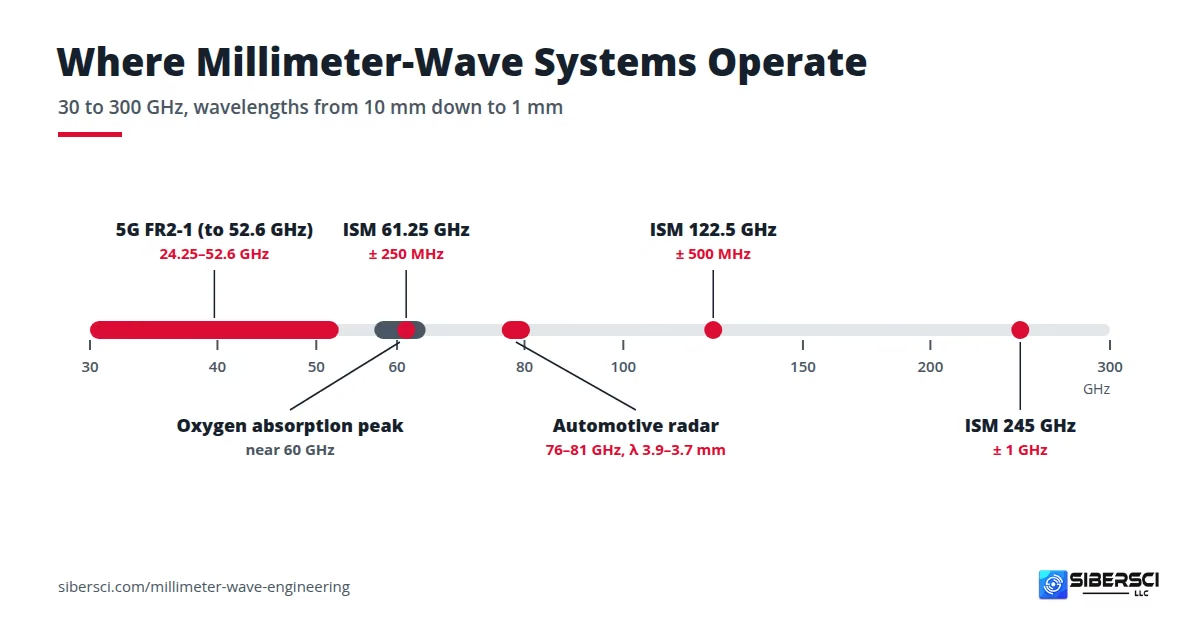
Large parts of the band, once used mostly for radio astronomy, military and satellite systems, are now open to commercial products. 5G FR2 uses 24.25–52.6 GHz. Automotive radar sits at 76–81 GHz, with wavelengths near 3.8 mm. The FCC also lists ISM frequencies at 61.25, 122.5 and 245 GHz in 47 CFR 18.301. Around 60 GHz, oxygen in the air absorbs strongly, which limits range but also helps short links avoid interfering with each other.
What SiberSci Designs, Tests and Fixes
- Front ends and active circuits: up- and down-converters, mixers, GaN and GaAs power amplifiers and LNAs, load-pull tuning, and temperature-stabilized Gunn diode oscillators
- Passive components: filters of every type, couplers, phase shifters, delay lines, matching networks and dielectric lenses
- Guided-wave parts: rectangular, circular and elliptic waveguide, coax, microstrip, stripline and coplanar waveguide; coaxial, cylindrical, rectangular, clamshell and dielectric resonators
- Systems: beamforming networks, software-defined radio hardware, signal integrity and system analysis
- Materials: temperature-dependent permittivity and permeability of solids, liquids, powders and plasmas at millimeter-wave frequencies
Every review is done under an NDA. If part of a specification cannot be met at these wavelengths, SiberSci explains why and proposes a change that works.
Simulation Backed by Measured Properties
At millimeter-wave frequencies, small errors in permittivity, loss tangent or surface roughness add up quickly. SiberSci runs HFSS, CST, COMSOL, FEKO, Sonnet, ADS or Genesys, on your licenses or through contract access, and uses material data measured near your operating frequency and temperature. If no such data exists, SiberSci arranges for it to be measured.
Electromagnetic Engineering Consulting Services offered:
- Antenna Engineering - https://sibersci.com/antenna-engineering/
- Microwave Engineering - https://sibersci.com/microwave-engineering/
- Microwave Heating Engineering - https://sibersci.com/microwave-heating-engineering/
- Millimeter-Wave Engineering - https://sibersci.com/millimeter-wave-engineering/
- RF Engineering - https://sibersci.com/rf-engineering/
- RF Heating Engineering - https://sibersci.com/rf-heating-engineering/
- RF and Microwave Safety - https://sibersci.com/rf-and-microwave-safety/
- Do not hesitate to ask if you need help solving a problem.
Electromagnetic Engineering Calculators offered:
- Circular Waveguide Calculator - https://sibersci.com/circular-waveguide-calculator/
- Coax TEM Mode Calculator - https://sibersci.com/coax-tem-mode-calculator/
- Dielectric Heating Calculator - https://sibersci.com/dielectric-heating-calculator/
- Rectangular Waveguide TEm,n Calculator - https://sibersci.com/rectangular-waveguide-temn-calculator/
- Rectangular Waveguide TMm,n Calculator - https://sibersci.com/rectangular-waveguide-tmmn-calculator/
- Skin Depth Calculator - https://sibersci.com/skin-depth-calculator/
- Wavelength Calculator - https://sibersci.com/wavelength-calculator/
Let’s Start Work On Your Project Today!
Starting work on your important project is relatively simple, so please submit your inquiry for a Millimeter-Wave Engineering Consulting project to Dr. Scott Best, and specifically state if a Non-Disclosure Agreement (NDA) is required to protect your business-sensitive information, Intellectual Property (IP) or Proprietary Data (PD). SiberSci, LLC will provide an NDA for review, negotiation, and amendment by the client to safeguard and protect their IP and PD. SiberSci, LLC will also provide a budgetary quotation and schedule for performing the client-defined Millimeter-Wave Engineering Consulting effort after reviewing the performance and size requirements. Work on the Millimeter-Wave Engineering Consulting project commences when a contract has been negotiated and legally executed by SiberSci, LLC and the client.
Millimeter-Wave Engineering FAQ
FAQ
What millimeter-wave engineering services does SiberSci, LLC provide?
SiberSci, LLC provides millimeter-wave engineering consulting across the 30 GHz to 300 GHz spectrum. Services include troubleshooting and optimizing existing millimeter-wave hardware, plus research, design, simulation, fabrication, testing, validation, and optimization of new devices, circuits, assemblies, subsystems, and systems for client-specific applications. Work is led by Dr. Scott Best.
What frequency range is considered millimeter-wave?
The millimeter-wave spectrum covers 30 GHz to 300 GHz, where free-space wavelengths range from 10 mm down to 1 mm. It includes commonly used bands such as Ka-band, V-band, E-band, and W-band. SiberSci, LLC works across this entire range. You can check wavelengths with our Wavelength Calculator.
Can SiberSci fix performance problems in existing millimeter-wave hardware?
Yes. SiberSci, LLC diagnoses and optimizes existing millimeter-wave circuits and systems that are underperforming. It uses theoretical analysis, computational electromagnetic (CEM) simulation, and measurement to find the cause and recommend corrective design changes.
What millimeter-wave components can SiberSci design and optimize?
SiberSci, LLC designs and optimizes a wide range of millimeter-wave components:
- Filters (lowpass, highpass, bandpass, band-reject)
- Resonators and cavities
- Power combiners and splitters
- Couplers, phase shifters, and delay lines; impedance-matching circuits
- Dielectric lenses
- Transmission line networks
- RF front-ends with up- and down-converters, and beamforming networks
- Software-Defined Radio (SDR) hardware
Signal integrity (SI) analysis is also offered.
Which millimeter-wave transmission line types does SiberSci work with?
SiberSci, LLC works with both waveguide and planar transmission lines. Waveguide types include coaxial, rectangular, cylindrical, elliptic, and ridged waveguide. Planar types include microstrip, stripline, coplanar waveguide (CPW), and finline circuits.
Does SiberSci design millimeter-wave amplifiers and oscillators?
Yes. SiberSci, LLC designs GaN and GaAs power amplifiers, low-noise amplifiers (LNAs), and application-specific amplifiers, including load-pull optimization of the active devices. It also develops temperature-stabilized Gunn diode oscillators.
What electromagnetic simulation software does SiberSci use for millimeter-wave design?
SiberSci, LLC is experienced with Ansys HFSS, CST Microwave Studio, COMSOL, FEKO, Sonnet, and Keysight ADS, and Genesys. Clients may specify a preferred tool if they provide a valid license or pay for contract access. Otherwise, SiberSci can recommend the most appropriate CEM code for the project.
Why do material properties matter for accurate millimeter-wave simulation?
At millimeter-wave frequencies, simulation accuracy depends heavily on frequency- and temperature-dependent material data such as complex permittivity, loss tangent, electrical conductivity, and thermal conductivity. Datasheet values are often specified at lower frequencies, so SiberSci, LLC helps clients obtain measured material properties so simulations reflect real hardware performance.
Can SiberSci measure dielectric properties at millimeter-wave frequencies?
Yes. SiberSci, LLC performs millimeter-wave dielectric characterization of temperature-dependent complex permittivity and permeability for solids, liquids, powders, and plasmas, using laboratory and contract measurement resources.
Can SiberSci tell me whether my millimeter-wave specifications are achievable?
Yes. SiberSci, LLC reviews performance specifications, size constraints, and proposed hardware configurations to determine whether they suit the intended application. If any requirement is physically impossible to meet, those problem areas are identified along with recommendations for working around them.
What industries and applications use SiberSci's millimeter-wave engineering services?
Millimeter-wave engineering supports 5G and other commercial wireless products, satellite systems, secure communications, radio astronomy, and military and government systems. SiberSci, LLC supports both commercial and government clients developing hardware for these applications.
Will SiberSci sign a non-disclosure agreement (NDA) before reviewing my project?
Yes. On request, SiberSci, LLC provides an NDA that the client can review, negotiate, and amend to protect business-sensitive information, intellectual property (IP), and proprietary data before project details are shared.
How do I start a millimeter-wave engineering consulting project with SiberSci?
Email Dr. Scott Best at scott_best@sibersci.com or call 270-228-4901, and state whether an NDA is required. After reviewing your performance and size requirements, SiberSci, LLC provides a budgetary quotation and schedule. Work begins once a contract is negotiated and executed by both parties.
Who is SiberSci, LLC and where is it located?
SiberSci, LLC is an electromagnetic engineering consulting firm based in Owensboro, Kentucky, founded on the industry and government experience of Dr. Scott Best. The firm is listed in the IEEE-USA Consultants Database and is a BBB Accredited Business, and it serves clients nationwide. Learn more about SiberSci.
Does SiberSci offer engineering services beyond millimeter-wave?
Yes. SiberSci, LLC also provides antenna engineering, RF engineering, microwave engineering, RF heating and microwave heating engineering, and RF and microwave safety consulting. The site also offers free calculators for rectangular and circular waveguide, coax TEM mode, skin depth, wavelength, and dielectric heating.

SiberSci, LLC is built upon the professional experience of Dr. Scott Best, who has worked in both industry and government. His professional experience has witnessed dramatic changes in techniques available for solving Electromagnetic Engineering problems, as well as for performing laboratory measurements and experiments.


Consulting Services
Contact
SiberSci, LLC is ready to begin solving your Electromagnetic Engineering problems today.