

Microwave Engineering Consulting Services from 300 MHz to 30 GHz
SiberSci, LLC designs, analyzes and repairs microwave circuits, components and subsystems across the UHF, L, S, C, X, Ku and K bands. Founder & CTO Dr. Scott Best, Ph.D., checks every simulation against closed-form theory and lab measurements before any hardware is built. As Chief Scientist at MPD, Inc. (2008–2013), he raised magnetron first-pass yield from as low as 10% to 90% or better.
Microwave problems SiberSci solves:
- Amplifiers that oscillate, run hot, or miss their gain, output power or efficiency targets
- Filters, couplers and power dividers with too much insertion loss or poor isolation
- Mismatch and high VSWR at connectors, transitions and waveguide flanges
- Low production yield from tight tolerances or unstable materials
- Turning a working prototype into a design that costs less to build
Contact SiberSci, LLC to start your microwave engineering project.
Microwave Engineering at a Glance
| Frequency range | 300 MHz to 30 GHz (free-space wavelength 1 m to 1 cm) |
| Typical hardware | Amplifiers, oscillators, filters, couplers, power combiners, mixers, resonators, phase shifters, delay lines and matching networks |
| Transmission media | Coax; rectangular, circular, elliptic and ridged waveguide; microstrip, stripline, coplanar waveguide and finline |
| Simulation tools | Ansys HFSS, CST Studio Suite, COMSOL, FEKO, Sonnet, Keysight ADS and Genesys |
| Measurement | Lab capability from 1 µHz to 300 GHz |
| Led by | Dr. Scott Best, Ph.D., Founder & CTO, IEEE Life Senior Member, 3 U.S. patents |
| Location | Owensboro, Kentucky; clients across the U.S. |
Microwave Bands and Wavelengths
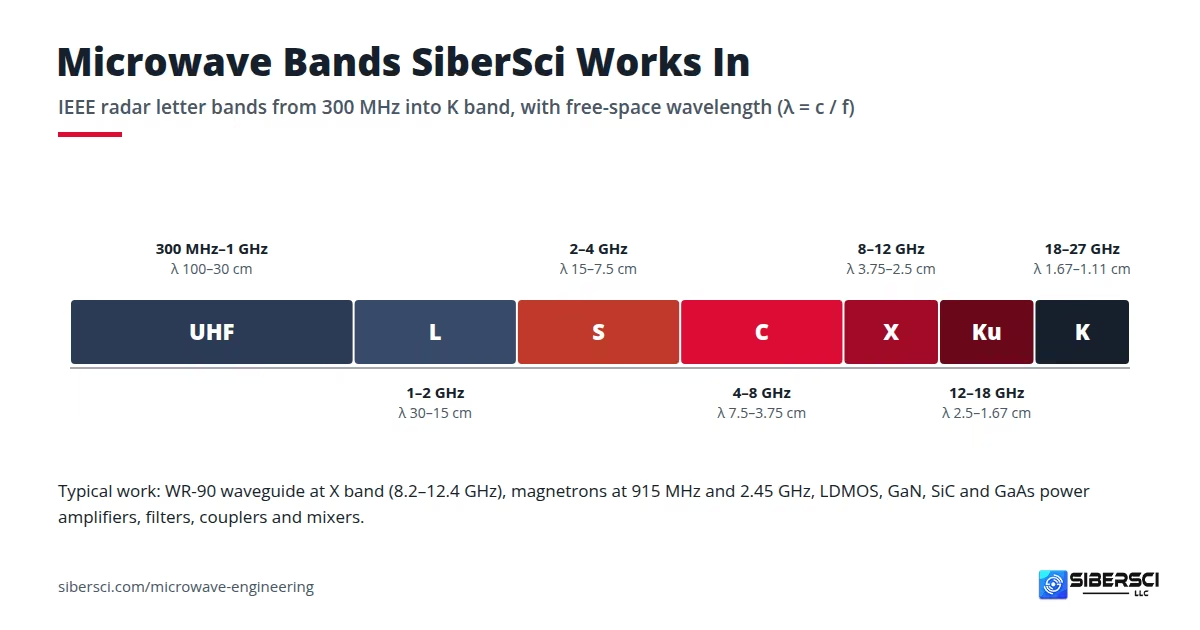
| IEEE band | Frequency | Free-space wavelength |
|---|---|---|
| UHF (upper) | 300 MHz–1 GHz | 100–30 cm |
| L | 1–2 GHz | 30–15 cm |
| S | 2–4 GHz | 15–7.5 cm |
| C | 4–8 GHz | 7.5–3.75 cm |
| X | 8–12 GHz | 3.75–2.5 cm |
| Ku | 12–18 GHz | 2.5–1.67 cm |
| K | 18–27 GHz | 1.67–1.11 cm |
Band edges follow IEEE Std 521. Wavelength λ = c / f. Work above 30 GHz is covered on the millimeter-wave engineering page.
Worked Example: Why WR-90 Is Used from 8.2 to 12.4 GHz
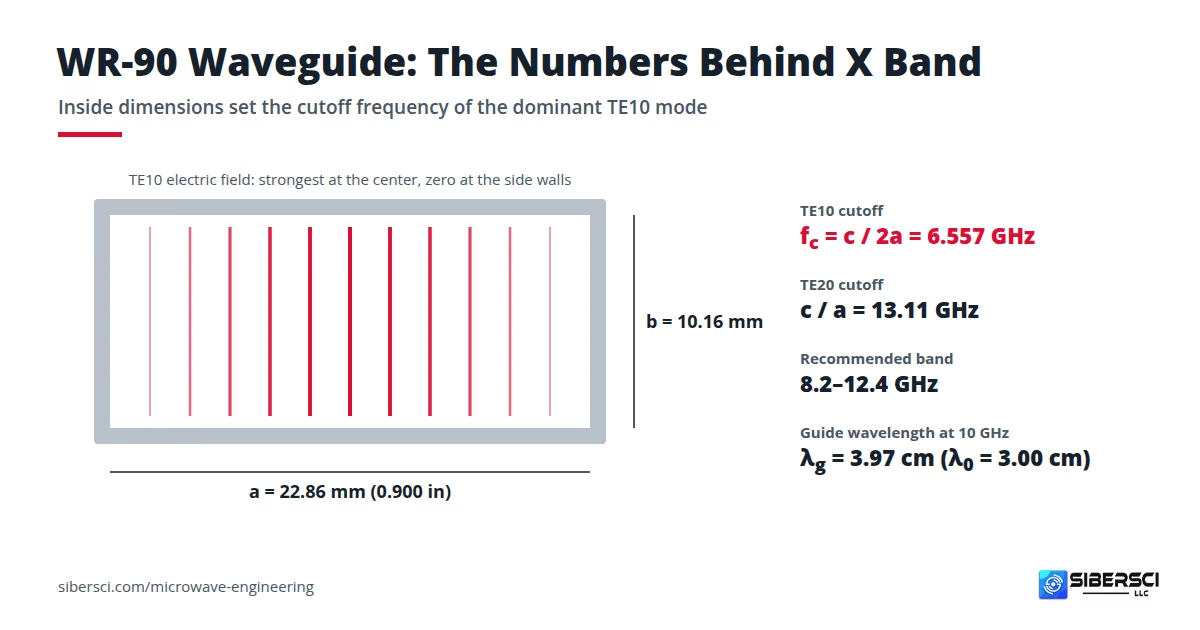
WR-90 waveguide has inside dimensions a = 22.86 mm and b = 10.16 mm. The dominant TE10 mode cuts off at fc = c / 2a = 6.557 GHz, and the next mode (TE20) at c / a = 13.11 GHz. Staying about 25% above the first cutoff and below the second gives the standard 8.2–12.4 GHz band, where only one mode propagates and loss stays low. At 10 GHz the guide wavelength is 3.97 cm, longer than the 3.00 cm free-space wavelength. You can check other sizes with the rectangular waveguide calculator.
What SiberSci Designs, Tests and Fixes
Each project starts under an NDA with your specifications and size limits. SiberSci then proposes one or more ways to build the hardware, notes where a requirement conflicts with physics, and shows what change would make it achievable. Typical work falls into four groups:
- Active circuits: power amplifiers on LDMOS, GaN, SiC or GaAs transistors, LNAs, load-pull tuning of transistors, and temperature-stabilized Gunn diode oscillators
- Passive components: lowpass, bandpass, highpass and band-reject filters; couplers; phase shifters; delay lines; matching networks; dielectric lenses
- Resonators and guided-wave parts: coaxial, cylindrical, rectangular, clamshell and dielectric resonators; coax and waveguide transmission lines
- Systems: RF front ends, software-defined radio hardware, beamforming networks, signal integrity and system-level analysis
One client cut its costs by more than $40,000 per month after SiberSci redesigned a radar mixer.
Simulation Checked Against Theory and Measured Material Data
SiberSci uses whichever electromagnetic solver fits the job, or the one your team already licenses: Ansys HFSS, CST Studio Suite, COMSOL, FEKO, Sonnet, Keysight ADS or Genesys. Solver results are only as good as their inputs, so SiberSci verifies boundary conditions with hand calculations and uses measured permittivity, loss tangent and conductivity at your operating frequency and temperature. When that data does not exist, SiberSci arranges for the materials to be measured.
Electromagnetic Engineering Consulting Services offered:
- Antenna Engineering - https://sibersci.com/antenna-engineering/
- Microwave Engineering - https://sibersci.com/microwave-engineering/
- Microwave Heating Engineering - https://sibersci.com/microwave-heating-engineering/
- Millimeter-Wave Engineering - https://sibersci.com/millimeter-wave-engineering/
- RF Engineering - https://sibersci.com/rf-engineering/
- RF Heating Engineering - https://sibersci.com/rf-heating-engineering/
- RF and Microwave Safety - https://sibersci.com/rf-and-microwave-safety/
- Do not hesitate to ask if you need help solving a problem.
Electromagnetic Engineering Calculators offered:
- Circular Waveguide Calculator - https://sibersci.com/circular-waveguide-calculator/
- Coax TEM Mode Calculator - https://sibersci.com/coax-tem-mode-calculator/
- Dielectric Heating Calculator - https://sibersci.com/dielectric-heating-calculator/
- Rectangular Waveguide TEm,n Calculator - https://sibersci.com/rectangular-waveguide-temn-calculator/
- Rectangular Waveguide TMm,n Calculator - https://sibersci.com/rectangular-waveguide-tmmn-calculator/
- Skin Depth Calculator - https://sibersci.com/skin-depth-calculator/
- Wavelength Calculator - https://sibersci.com/wavelength-calculator/
Are You Ready To Contact Us For Your Microwave Engineering Project?
We can start work on your project today, so please submit your inquiry for a Microwave Engineering Consulting project to Dr. Scott Best, and specifically state if a Non-Disclosure Agreement (NDA) is required to protect your business-sensitive information, Intellectual Property (IP), or Proprietary Data (PD). SiberSci, LLC will provide an NDA for review, negotiation, and amendment by the client to safeguard and protect their IP and PD. SiberSci, LLC will also provide a budgetary quotation and schedule for performing the client-defined Microwave Consulting effort after reviewing the performance and size requirements. Work on the Microwave Consulting project commences when a contract has been negotiated and legally executed by SiberSci, LLC and the client.
Microwave Engineering FAQ
FAQ
What microwave engineering services does SiberSci, LLC offer?
SiberSci, LLC provides microwave engineering consulting for two kinds of work: troubleshooting and optimizing existing microwave hardware, and the research, design, development and optimization of new hardware. Services include theoretical analysis, design, fabrication, testing, validation and optimization of microwave devices, circuits, assemblies, subsystems and complete systems.
What frequency range does SiberSci's microwave engineering cover?
SiberSci's microwave engineering services cover hardware operating from 300 MHz to 30 GHz. Work above 30 GHz is handled through SiberSci's millimeter-wave engineering services, and lower-frequency work through its RF engineering services, so projects that span several bands can stay with one consultant.
What types of microwave circuits and components can SiberSci design?
SiberSci designs and optimizes microwave transmission lines (coaxial; rectangular, cylindrical, elliptic and ridged waveguide; microstrip, stripline, coplanar waveguide, and finline), filters (lowpass, highpass, bandpass, and band-reject), cavities and resonators, power combiners, and splitters, couplers, phase shifters, delay lines, impedance-matching networks, dielectric lenses, software-defined radio RF front ends, and beamforming networks. Signal integrity (SI) analysis and systems analysis are also offered.
Does SiberSci design microwave amplifiers and oscillators?
Yes. SiberSci designs LDMOS, GaN, SiC, and GaAs power amplifiers, low-noise amplifiers (LNAs), and application-specific amplifiers, including load-pull optimization of active device performance. SiberSci also develops temperature-stabilized Gunn diode oscillators.
Can SiberSci fix a microwave circuit that is not meeting its specifications?
Yes. Optimizing the performance of existing microwave circuits is one of SiberSci's core services. SiberSci analyzes the existing hardware analytically and numerically to find why it is underperforming, then recommends and validates the design changes needed to meet the specification.
Can SiberSci tell me whether my microwave design concept is feasible before I build it?
Yes. SiberSci reviews a client's performance specifications and size constraints and recommends one or more hardware configurations that can meet them, or evaluates a design concept the client has already proposed. The review documents the performance and physical limits of each concept and the modifications it needs. If part of a specification is physically impossible to achieve, SiberSci identifies it and recommends ways around the barrier.
Which electromagnetic simulation (CEM) software does SiberSci use?
SiberSci uses Ansys HFSS (Ansys Electronics Workbench), CST Microwave Studio (CST Studio Suite), FEKO, COMSOL, Sonnet, Keysight ADS, and Genesys. Clients can specify a particular tool if they provide a valid license or pay for contract access to it. Clients who are unsure which tool fits their project can have SiberSci recommend one.
Why does SiberSci validate simulation results with analytical methods?
A numerical simulation is only as accurate as its model parameters and boundary conditions, and errors are easy to miss. SiberSci checks every numerical simulation against analytical techniques before hardware is fabricated, which prevents clients from spending time and money building prototypes based on faulty simulation results.
Why do material properties matter in microwave design, and can SiberSci measure them?
Simulation accuracy depends on the frequency- and temperature-dependent properties of the metals and dielectrics used, such as complex permittivity, loss tangent, electrical conductivity, thermal conductivity, density and specific heat. SiberSci has laboratory and contract resources to measure these properties, and provides RF, microwave, millimeter-wave and THz dielectric characterization of the temperature-dependent complex permittivity and permeability of plasmas, powders, liquids and solids.
Will SiberSci sign a non-disclosure agreement (NDA) to protect my intellectual property?
Yes. When you submit an inquiry, state that an NDA is required. SiberSci will provide an NDA for your review, negotiation, and amendment to protect your business-sensitive information, intellectual property (IP), and proprietary data before project details are shared.
How do I start a microwave engineering project with SiberSci, and how is it priced?
Email Dr. Scott Best at scott_best@sibersci.com or call 270-228-4901 with your performance and size requirements. After reviewing them, SiberSci provides a budgetary quotation and schedule for the defined scope of work. Pricing is project-specific, and work begins once a contract has been negotiated and executed by both parties.
Who is the engineer behind SiberSci, LLC?
SiberSci, LLC is built on the professional experience of Dr. Scott Best, who has worked in both industry and government on electromagnetic engineering problems and laboratory measurements. SiberSci is listed in the IEEE-USA Consultants Database, is a BBB Accredited Business, and is based in Owensboro, Kentucky.

SiberSci, LLC is built upon the professional experience of Dr. Scott Best, who has worked in both industry and government. His professional experience has witnessed dramatic changes in techniques available for solving Electromagnetic Engineering problems, as well as for performing laboratory measurements and experiments.


Consulting Services
Contact
SiberSci, LLC is ready to begin solving your Electromagnetic Engineering problems today.