
Microwave Heating Engineering Consulting Services at 915 MHz, 2.45 GHz, 5.8 GHz and 24.125 GHz
SiberSci, LLC designs and troubleshoots microwave heating, drying and processing systems for laboratory and industrial use, sized from measured properties of the material you need to heat. Founder & CTO Dr. Scott Best, Ph.D., has worked on commercial microwave oven development, and as Chief Scientist at MPD, Inc. (2008–2013) he rebuilt its magnetron product lines. He is a member of the International Microwave Power Institute (IMPI).
Microwave heating problems SiberSci solves:
- Hot spots, cold spots and thermal runaway in the load
- Arcing in waveguide or the applicator, and short magnetron life
- Reflected power that changes as the material heats or dries
- Choosing between a magnetron and a solid-state source
- Scaling a batch process to continuous flow
Contact SiberSci, LLC to start your microwave heating project.
Microwave Heating Engineering at a Glance
| ISM frequencies | 915 MHz, 2.45 GHz, 5.8 GHz and 24.125 GHz (FCC Part 18) |
| Materials heated | Solids, films, powders and liquids, in batch or continuous flow |
| Typical uses | Food processing, drying, polymer and chemical processing, wood products, plasma sources for semiconductor processing |
| Power sources | Magnetrons, klystrons, TWTs and gyrotrons; LDMOS, GaN and SiC solid-state amplifiers |
| Simulation tools | Ansys HFSS, CST Studio Suite and COMSOL Multiphysics, including temperature-dependent coupled models |
| Led by | Dr. Scott Best, Ph.D., Founder & CTO, IEEE Life Senior Member, IMPI member |
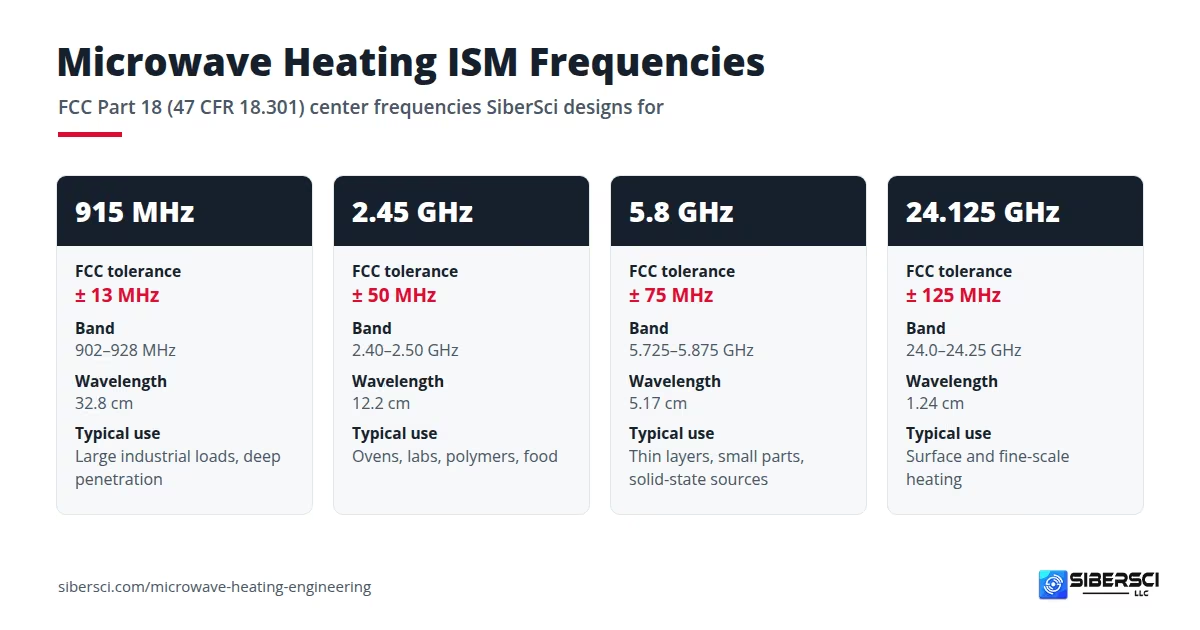
Microwave Heating Frequencies and FCC Tolerances
| Center frequency | FCC tolerance | Wavelength in air |
|---|---|---|
| 915 MHz | ± 13 MHz | 32.8 cm |
| 2.45 GHz | ± 50 MHz | 12.2 cm |
| 5.8 GHz | ± 75 MHz | 5.17 cm |
| 24.125 GHz | ± 125 MHz | 1.24 cm |
Tolerances from 47 CFR 18.301. Lower frequencies penetrate deeper into a lossy load; higher frequencies suit thin layers and small parts.
Worked Example: How Much Heat Does the Field Deliver?
The power absorbed per unit volume is P = 2πf · ε0 · ε″ · E², where ε″ is the material's dielectric loss factor and E is the RMS electric field. At 2.45 GHz, a material with ε″ = 10 in a 1 kV/m field absorbs about 1.36 × 10⁶ W/m³, or 1.36 W per cubic centimeter. Doubling the field quadruples the heating, which is why hot spots form wherever the field peaks. You can run this load analysis yourself with the dielectric heating calculator.
How SiberSci Builds a Microwave Heating System
Under an NDA, SiberSci starts with your material data, the temperature you need to reach, how much material, and how fast. From that it sizes the power, picks the frequency and source, and designs the applicator. Where a target cannot be met, the review says so and suggests a workable alternative. SiberSci has worked with:
- Vacuum electron devices: magnetrons, klystrons, traveling-wave tubes and gyrotrons
- Solid-state sources: LDMOS, GaN and SiC amplifiers and oscillators, and combining several sources in transmission line, resonator or free space
- Applicators: cylindrical, rectangular and clamshell resonators in fundamental or higher-order modes, and overmoded oven cavities
- Process measurement: fiber-optic temperature probes and IR cameras inside the applicator, plus temperature- and frequency-dependent permittivity, loss tangent, conductivity, thermal conductivity, diffusivity, density and specific heat

Coupled Electromagnetic and Thermal Simulation
A material's permittivity changes as it heats, so a field-only model can mislead. SiberSci runs coupled electromagnetic and thermal models in HFSS, CST or COMSOL, using your licenses or contract access, and feeds them measured temperature-dependent properties. When that data is missing, SiberSci arranges lab measurements before committing to a design.
Try the Free Dielectric Heating Calculator
The SiberSci dielectric heating calculator gives a one-dimensional estimate of the RF power and field strength needed to raise a material's temperature by a set amount in a set time. Enter density, specific heat and complex permittivity at your temperature and frequency. A tutorial is included. The answer is only as good as the inputs: properties that do not apply to your temperature or frequency range will give an unrealistic result.
Electromagnetic Engineering Consulting Services offered:
- Antenna Engineering - https://sibersci.com/antenna-engineering/
- Microwave Engineering - https://sibersci.com/microwave-engineering/
- Microwave Heating Engineering - https://sibersci.com/microwave-heating-engineering/
- Millimeter-Wave Engineering - https://sibersci.com/millimeter-wave-engineering/
- RF Engineering - https://sibersci.com/rf-engineering/
- RF Heating Engineering - https://sibersci.com/rf-heating-engineering/
- RF and Microwave Safety - https://sibersci.com/rf-and-microwave-safety/
- Do not hesitate to ask if you need help solving a problem.
Electromagnetic Engineering Calculators offered:
- Circular Waveguide Calculator - https://sibersci.com/circular-waveguide-calculator/
- Coax TEM Mode Calculator - https://sibersci.com/coax-tem-mode-calculator/
- Dielectric Heating Calculator - https://sibersci.com/dielectric-heating-calculator/
- Rectangular Waveguide TEm,n Calculator - https://sibersci.com/rectangular-waveguide-temn-calculator/
- Rectangular Waveguide TMm,n Calculator - https://sibersci.com/rectangular-waveguide-tmmn-calculator/
- Skin Depth Calculator - https://sibersci.com/skin-depth-calculator/
- Wavelength Calculator - https://sibersci.com/wavelength-calculator/
Here Is What You Need To Do To Start A Microwave Heating Engineering Project!
Your company has an important problem that needs to be solved professionally, so please submit your inquiry for a Microwave Heating Engineering Consulting project to Dr. Scott Best, and specifically state if a Non-Disclosure Agreement (NDA) is required to protect business-sensitive information, Intellectual Property (IP) or Proprietary Data (PD). SiberSci, LLC will provide an NDA for review, negotiation, and amendment by the client to safeguard and protect their IP and PD. SiberSci, LLC will also provide a budgetary quotation and schedule for performing the client-defined Microwave Heating Consulting effort after reviewing the performance and size requirements. Work on the Microwave Heating Engineering Consulting project commences when a contract has been negotiated and legally executed by SiberSci, LLC and the client.
Microwave Heating Engineering FAQ
FAQ
What does a microwave heating engineering consultant do?
A microwave heating engineering consultant designs, analyzes, and troubleshoots systems that use microwave energy to heat, dry, cure, or process materials. SiberSci, LLC, led by Dr. Scott Best, provides theoretical analysis, design, development, fabrication, testing, validation, and optimization of microwave heating systems for laboratory and industrial applications. It also improves the performance of existing microwave heating equipment.
What frequencies does SiberSci design microwave heating systems for?
SiberSci, LLC designs microwave heating hardware at 915 MHz, 2.45 GHz, 5.8 GHz, and 24 GHz. These are the frequencies commonly allocated for industrial, scientific, and medical (ISM) heating use. The best frequency depends on the material's dielectric properties, the required penetration depth, the size of the load, and the available power sources.
Should I use 915 MHz or 2.45 GHz for industrial microwave heating?
915 MHz has a longer wavelength than 2.45 GHz, so it generally penetrates deeper into a material and suits large, thick loads and high-power industrial lines. 2.45 GHz is better suited to smaller loads, thinner products, and compact equipment. The right choice depends on the material's complex permittivity and loss tangent measured at operating temperature, which SiberSci, LLC evaluates before recommending a frequency.
What is the difference between magnetron and solid-state microwave heating sources?
Magnetrons are vacuum electronic devices that deliver high power at low cost per watt. Solid-state amplifiers built on LDMOS, GaN, or SiC transistors offer precise control of frequency, phase, and power, which can improve heating uniformity and process repeatability. SiberSci, LLC works with magnetrons, klystrons, TWTs, gyrotrons, and LDMOS, GaN, and SiC solid-state sources. It can also combine power from multiple sources.
What materials and industries use microwave heating?
Microwave heating is used in:
- food processing
- chemical manufacturing
- polymer processing
- wood products
- consumer and industrial goods
- semiconductor plasma processing for wafer fabrication
SiberSci, LLC supports batch and continuous-flow processing of dielectric materials in the form of solids, films, powders, and liquids.
Why do material properties matter in microwave heating design?
How fast and how evenly a material heats depends on its complex permittivity, loss tangent, electrical conductivity, thermal conductivity, density, and specific heat. These properties change with frequency and temperature. Simulations and designs built on inaccurate or room-temperature-only data can fail in production. SiberSci, LLC arranges measurement of frequency- and temperature-dependent material properties so designs and simulations are based on valid data.
Can SiberSci fix problems with an existing microwave heating system?
Yes. SiberSci, LLC optimizes existing microwave heating circuits, including:
- impedance matching
- applicator and cavity design
- transmission line networks
- filters
- power combining
Temperature inside resonators can be measured with optical thermometry and IR cameras to find uneven heating and diagnose performance problems.
What simulation software does SiberSci use for microwave heating?
SiberSci, LLC uses Ansys HFSS, CST Studio Suite, and COMSOL Multiphysics for computational electromagnetics (CEM) and temperature-dependent multiphysics simulation of dielectric materials. Clients may specify a preferred tool if they provide a valid license or pay for contract access. SiberSci can also help clients choose the most appropriate code for their project.
What types of microwave heating applicators can SiberSci design?
SiberSci, LLC designs single-mode and multimode applicators. These include cylindrical, rectangular, and clamshell resonators operating in fundamental or higher-order modes, and over-moded oven-style cavities. Supporting hardware includes:
- coaxial, rectangular, cylindrical, elliptic, and ridged waveguide
- power combiners and splitters
- filters
- impedance matching circuits
How do I estimate the microwave power needed to heat a material?
Start with a load analysis. The energy required equals mass times specific heat times temperature rise. Divide that by the allowed heating time, then add losses. The power absorbed per unit volume is proportional to frequency, the dielectric loss factor, and the square of the electric field strength. SiberSci's free Dielectric Heating Calculator gives a 1-D estimate of the power and electric field required. The estimate is only valid if you enter accurate temperature- and frequency-dependent material data.
Will SiberSci tell me if my heating requirements are physically impossible?
Yes. During the review, SiberSci, LLC documents the performance and physical limits of each microwave heating concept. If part of a client's specification cannot be achieved physically, those problem areas are identified along with recommendations for working around them.
Does SiberSci sign NDAs to protect proprietary material data?
Yes. SiberSci, LLC provides a Non-Disclosure Agreement for the client to review, negotiate, and amend before any proprietary material specifications, intellectual property, or business-sensitive data are shared.
How do I start a microwave heating engineering project with SiberSci?
Email Dr. Scott Best at scott_best@sibersci.com or call 270-228-4901. Include:
- the material
- its volume and mass
- the target temperature
- the allowed heating time
- whether an NDA is required
SiberSci, LLC then provides a budgetary quotation and schedule. Work begins once a contract is signed.
Who is SiberSci, and where is it located?
SiberSci, LLC is an electromagnetic engineering consulting firm based in Owensboro, Kentucky. It is built on the industry and government experience of Dr. Scott Best. It is listed in the IEEE-USA Consultants Database and is a BBB-accredited business. Its services include microwave heating, RF heating, microwave, RF, antenna, millimeter-wave, and RF and microwave safety engineering.

SiberSci, LLC is built upon the professional experience of Dr. Scott Best, who has worked in both industry and government. His professional experience has witnessed dramatic changes in techniques available for solving Electromagnetic Engineering problems, as well as for performing laboratory measurements and experiments.


Consulting Services
Contact
SiberSci, LLC is ready to begin solving your Electromagnetic Engineering problems today.